
UAE - Nigeria Comprehensive Economic Partnership Agreement
The UAE has become a major trade and investment partner for Africa, driven by its strategic interests in logistics, energy, agriculture, and digital infrastructure. Several African countries have signed Comprehensive Economic Partnership Agreements (CEPAs) with the UAE, signalling a shift toward deeper bilateral economic integration.
The UAE signed its first bilateral trade agreement in February 2022 and aims to deepen ties with strategic partners around the world. The latest to join the list of partners are Nigeria and Sierra Leone, which signed their CEPAs on 13 January 2026 and 2 February 2026, respectively.
The CEPAs are meant to expand markets access opportunities, while facilitating investment flows through the lowering or eliminating tariffs, simpler customs procedures, clear and transparent rules etc.
Events
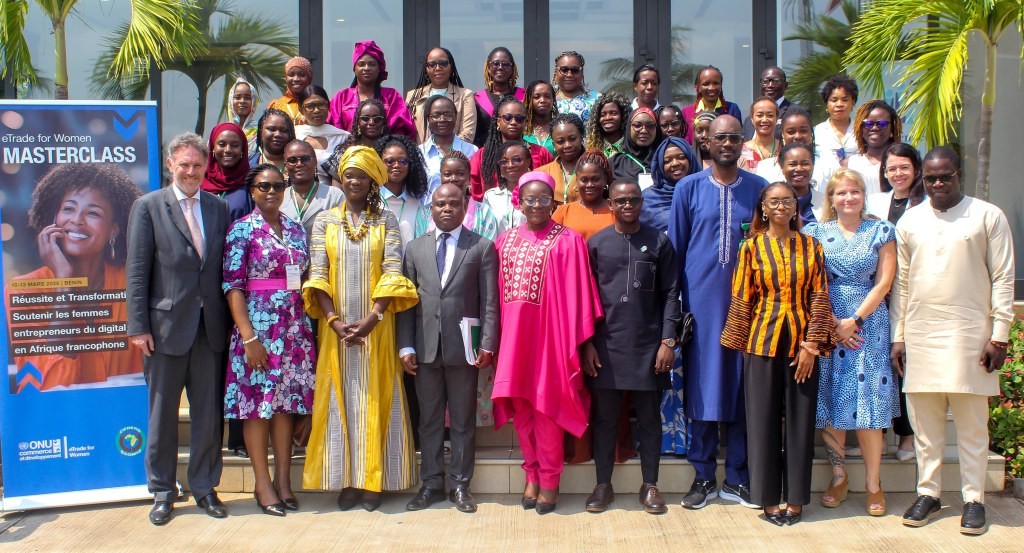
ECOWAS & UNCTAD Support Women Entrepreneurs to Leverage Digital Skills for Business Growth
The ECOWAS Commission, through the Directorate of Trade, in collaboration with the UN Trade and Development (UNCTAD), held a specialized Masterclass on ‘Success and Transformation: Supporting Women Digital Entrepreneurs’ from 10 - 13 March 2026 in Cotonou, Benin. The program sought to empower women entrepreneurs by strengthening their digital and entrepreneurial skills to capture emerging digital opportunities across Africa.
The opening remarks from Ambassadeur Simidélé Sèlidji Seth TEBE of the Ministry of Foreign Affairs, Republic of Benin highlighted that women run almost 40% of SMEs in the country and the government has invested more than 500 million CFA in ensuring that their businesses thrive. He stated that digitalization is at the heart of the national stability programme of Benin and women participation is of vital importance for this transformation. Delivering remarks on behalf of the ECOWAS Resident Representative to the Republic of Benin Ambassador Amadou DIONGUE, Mr. Mahueana HOUEDOU conveyed the appreciation of the ECOWAS Commissioner of Economic Affairs and Agriculture, Dr Kalilou SYLLA, to the Government of Benin and strategic partners.
He noted the Masterclass was a key intervention to bridge the digital divide and equip women entrepreneurs with the expertise to expand their enterprises and forms part of the broader ECOWAS E-Commerce Strategy. In his remarks, His Excellency Joris WP JURRIËNS, Ambassador of the Kingdom of the Netherlands to the Republic of Benin, highlighted that women entrepreneurs are essential for economic growth and women-led innovation is a foundation for inclusive, resilient, and sustainable development. He underscored empowering women as a clear-sighted economic choice which unleashes a transformative force within our economies.
The Resident Coordinator of the United Nations in Benin, Aminatou SAR, in her remarks noted that the Masterclass was held in the symbolic context of the International Women’s Day. She stated that justice for women means ensuring equal access to resources and removal of barriers to women’s economic participation which is where the digital economy becomes important.
In her remarks, Dr. Arielle AHOUANSOU, Co-Founder & CEO of Kea Medicals and eTrade for women ‘Advocate’ stated the digital economy is redefining the way we work, innovate and create value. She highlighted that despite the immense opportunities, women remain underrepresented in the digital economy. She underscored the importance of innovating women as a thriving society.
The opening ceremony also featured a goodwill message from the Deputy Secretary – General of UNCTAD, Pedro Manuel MORENO who stated that equal participation of women in the digital economy could add up to $280 billion to the region's GDP by 2030 representing millions of jobs. He emphasized that the Masterclass brings together a community of entrepreneurs to exchange experiences and solutions to overcome obstacles and build a more inclusive economy for all.
The Masterclass provided an opportunity for regional women-owned businesses to network with other businesses on the continent. It featured training on business structuring and planning, legal framework, AI for entrepreneurs, 60 second business pitch, networking, digital marketing etc. A public-private dialogue was also held which saw a panel composed of the ECOWAS representative, the government of Benin, and the private sector discuss with the entrepreneurs. Participants also visited one of the largest regional e-commerce businesses, GOZEM. The company tour included exchanges and experience sharing with the Global Head of Operations on building a sustainable regional e-commerce business.
The Masterclass concluded with participants receiving their certificates and integrated into the larger eTrade for Women global Network where they will continue to build strong relationships with like-minded women entrepreneurs at the regional and global levels.
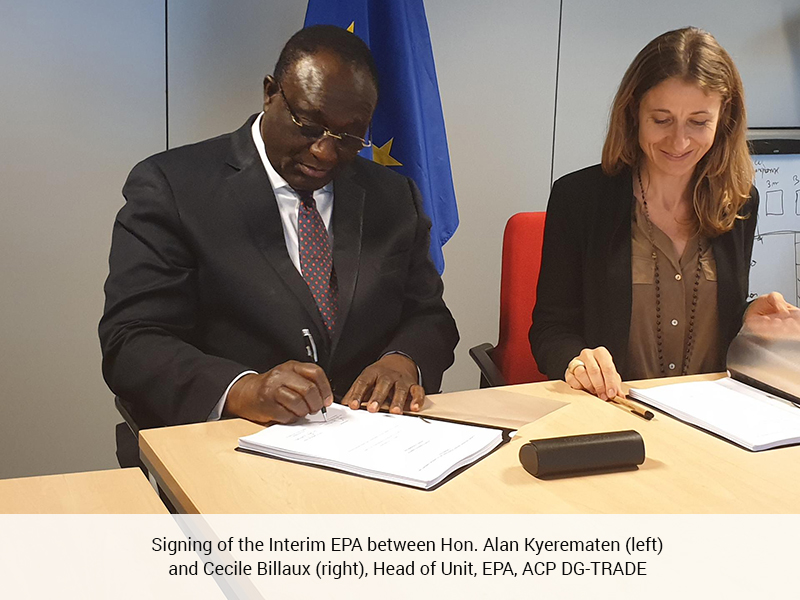
Ghana and Cote d’Ivoire have entered into Interim Economic Partnership Agreement (iEPA) with the European Union
Ghana and Cote d’Ivoire have entered into separate Interim Economic Partnership Agreement (iEPA) with the European Union
Ghana and the European Union iEPA have entered into a good only based bilateral market access agreement. The interim economic partnership agreement between Ghana and the EU was negotiated in 2007 and ratified by Ghana in 2016 and went into effect 1 July 2021.
Under the Agreement, Ghana would progressively liberalise tariffs for 80% of the total volume of exports from the EU to Ghana, with cumulative tariff cuts for approximately 22% of applicable tariff lines in 2021, 50% by 2024 and 100% by 2029.
The Interim Economic Partnership Agreement between Côte d’Ivoire and the EU was negotiated in 2008. Côte d’Ivoire ratified the Agreement in 2016. Under it, the EU provides duty-free, quota-free access for Côte d’Ivoire’s exports to the EU. For its part, Côte d’Ivoire is progressively reducing its tariffs to zero for 85 percent of its EU imports by 2029.
The gradual liberalization of Cote d’Ivoire’s market for EU products commenced 1 January 2019 with the process scheduled in five phases over a 10-year period, from 2019 to 2029. Côte d'Ivoire has liberalised 1080 tariff lines effective 1 January 2024, bringing the total number of liberalised tariff lines to 3385 or 55%.
Read more